
Overview
Correct export documentation and packing separate professional Chinese flange supplier programs from shipments that stall in customs or arrive with damaged facing finishes. Overseas buyers need mill test certificates (MTCs) tied to heat numbers, commercial invoices and packing lists that match physical counts, and inspection releases aligned with the purchase order—plus crating that survives sea freight humidity and handling.
This guide lists the documents and packing practices export teams should specify before production release on flange, pipe fitting, and valve orders from China.
Why It Matters for Pipe Components
Flanges are heavy, machined steel items with sensitive sealing faces. Poor packing leads to RF gouges, rust bloom, and bent hubs discovered only at site—after the installation crew is waiting. Documentation gaps cause equal pain: customs holds when invoice weights disagree with packing lists, or owner rejection when MTC heat numbers do not match stamped flanges.
Because flanges link to entire piping systems, receiving inspection must connect each component to paperwork before spool fabrication welds commingle heats. A Chinese flange supplier that organizes document binders by heat number and PO line saves weeks of chasing missing certificates compared with shipments where papers arrive separately by email.
Documentation Requirements and Packing Standards
| Document | Purpose | Common Issues to Prevent |
|---|---|---|
| Commercial invoice | Customs value and terms | HS code or description mismatch |
| Packing list | Piece count, weights, marks | Missing heat numbers per crate |
| Bill of lading | Title and freight handoff | Name inconsistent with consignee |
| MTC / mill test certificate | Material grade proof | Heat not matching physical stamp |
| Inspection report | Dimensional and NDE release | Batch ID not linked to shipment |
| Certificate of origin | Preferential duty if applicable | Wrong form for destination country |
| Third-party inspection | Owner or TPI release | dated after cargo departure |
MTC and Traceability Content
Each MTC in a Chinese flange supplier shipment should identify:
- Heat or melt number matching flange marking
- Material grade and specification (e.g., ASTM A105, A182 F316)
- Chemical composition and mechanical test results
- Heat treatment statement when required
- Quantity covered and reference to PO or line item
Request digital PDFs indexed by heat number plus one consolidated binder for site filing. For mixed shipments with pipe fittings and valves, separate sections by material family reduce receiving errors.
Marking on Flanges
Export marking should survive packing and short-term outdoor storage:
- Size, pressure class, and standard (e.g., 6 in Class 300 ASME B16.5)
- Heat number or batch traceability code
- Manufacturer name or logo
- Grade symbol for stainless and alloy
- Project tag when PO requires line or spool identification
Confirm marking location avoids facing surfaces and bolt holes.
Sea Freight Packing Methods
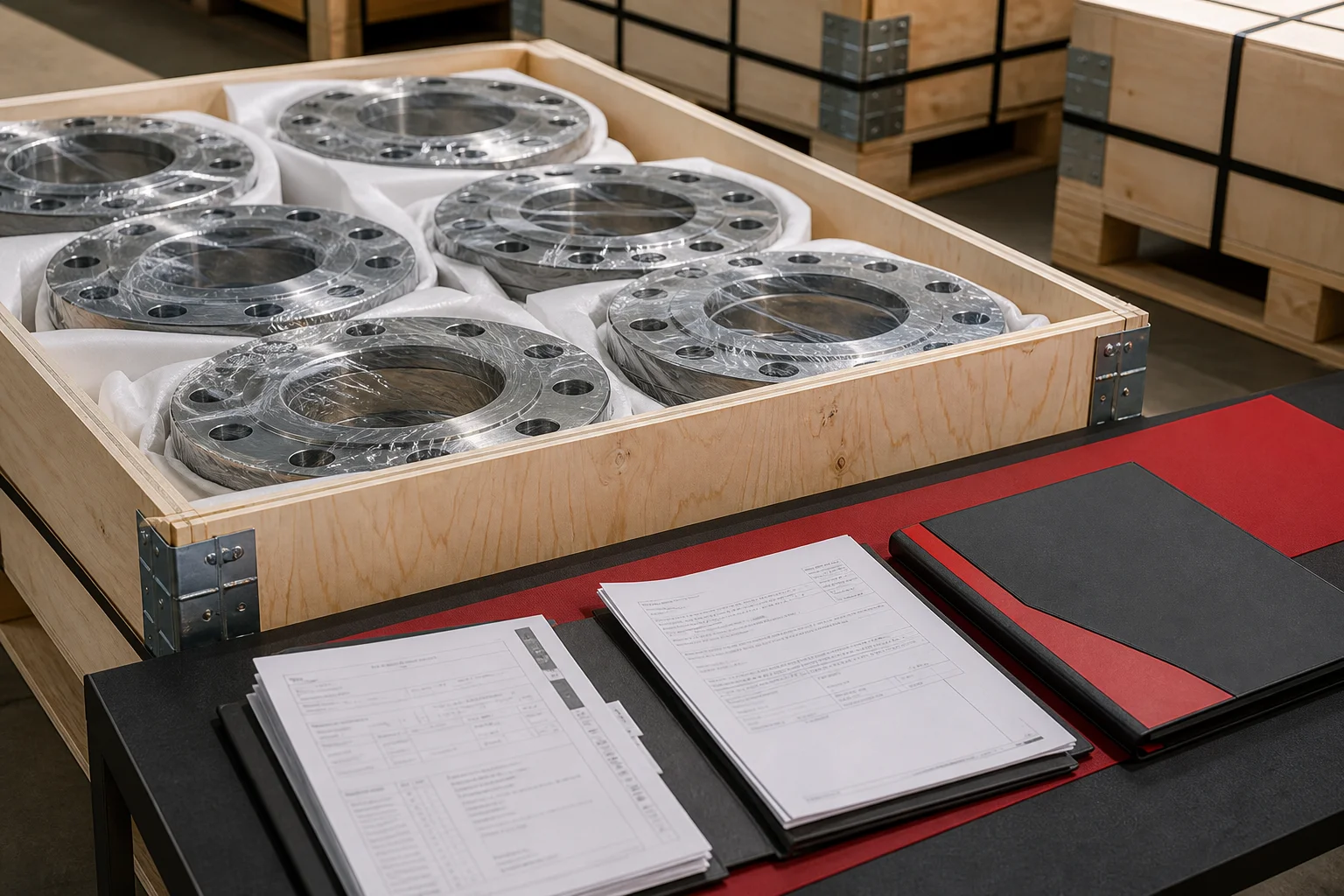
Standard good practice for Chinese flange export packing includes:
- Raised face protection — plastic or metal RF protectors on every flange
- RTJ groove protection — ring guards for ring-type joint finishes
- Bevel end caps — on weld neck hubs to prevent edge damage
- Bundle or crate — steel strapping on pallets or wooden crates sized for forklift handling
- VCI paper or rust preventive — on carbon steel for humid routes
- Desiccant — in closed crates for long transit
- Fumigation or ISPM-15 — on wooden crating when destination requires phytosanitary compliance
Photograph crates before container seal and share with the buyer for insurance and receiving prep.
Supplier and Receiving Checklist
Before accepting shipment from a Chinese flange supplier, verify:
- [ ] Invoice, packing list, and BL consignee data match your import setup
- [ ] Piece count and total weight agree across documents
- [ ] Every heat number on flanges has a corresponding MTC
- [ ] Inspection release covers the shipped batch and inspection level on PO
- [ ] RF protectors present; no metal-to-metal facing contact in crates
- [ ] Marking legible after uncrating
- [ ] CO and special certificates included for destination customs
- [ ] Email PDF package matches physical document pouch in container
Hebei Noan Pipe Equipment prepares export documentation packages and flange packing from Mengcun, Hebei, structured for international customs and owner receiving—often aligned with pipe fittings and valve shipments on shared project numbers.
FAQ
What HS code is used for forged steel flanges from China?
Classification depends on material and finish; confirm with your customs broker using the invoice description and local tariff rules. Provide accurate material and product descriptions on the PO to avoid broker guesswork.
Should MTCs be originals or PDF copies?
Many projects accept certified PDFs if the PO allows; others require originals stamped by mill or supplier. Define format in the purchase order before production.
Who pays for rework if packing fails and faces are damaged?
Responsibility follows Incoterms and PO warranty clauses. Specify packing standard in the PO and inspect at port or upon delivery to document damage for insurance or supplier claim quickly.
Next Steps
Attach your documentation template, marking specification, and packing requirement to the next RFQ so the Chinese flange supplier quotes admin and crating correctly. Contact Hebei Noan Pipe Equipment for export-ready flange shipments with MTC binders, inspection releases, and sea freight packing suited to your destination port and owner standards.
Request a Quote