Overview
G 1/2 and 1/2 NPT are different nominal half-inch pipe-thread connections. G 1/2 is a parallel BSPP thread associated with the ISO 228 system and normally seals through a washer, O-ring, gasket, bonded seal, or defined seat. 1/2 NPT is a tapered American pipe thread under ASME B1.20.1 and commonly seals through thread interference with an approved sealant.
They differ in thread profile, pitch, diameter system, taper, gauging, and sealing method. They should not be assembled directly merely because both names contain “1/2.”
Why It Matters for Pipe Components
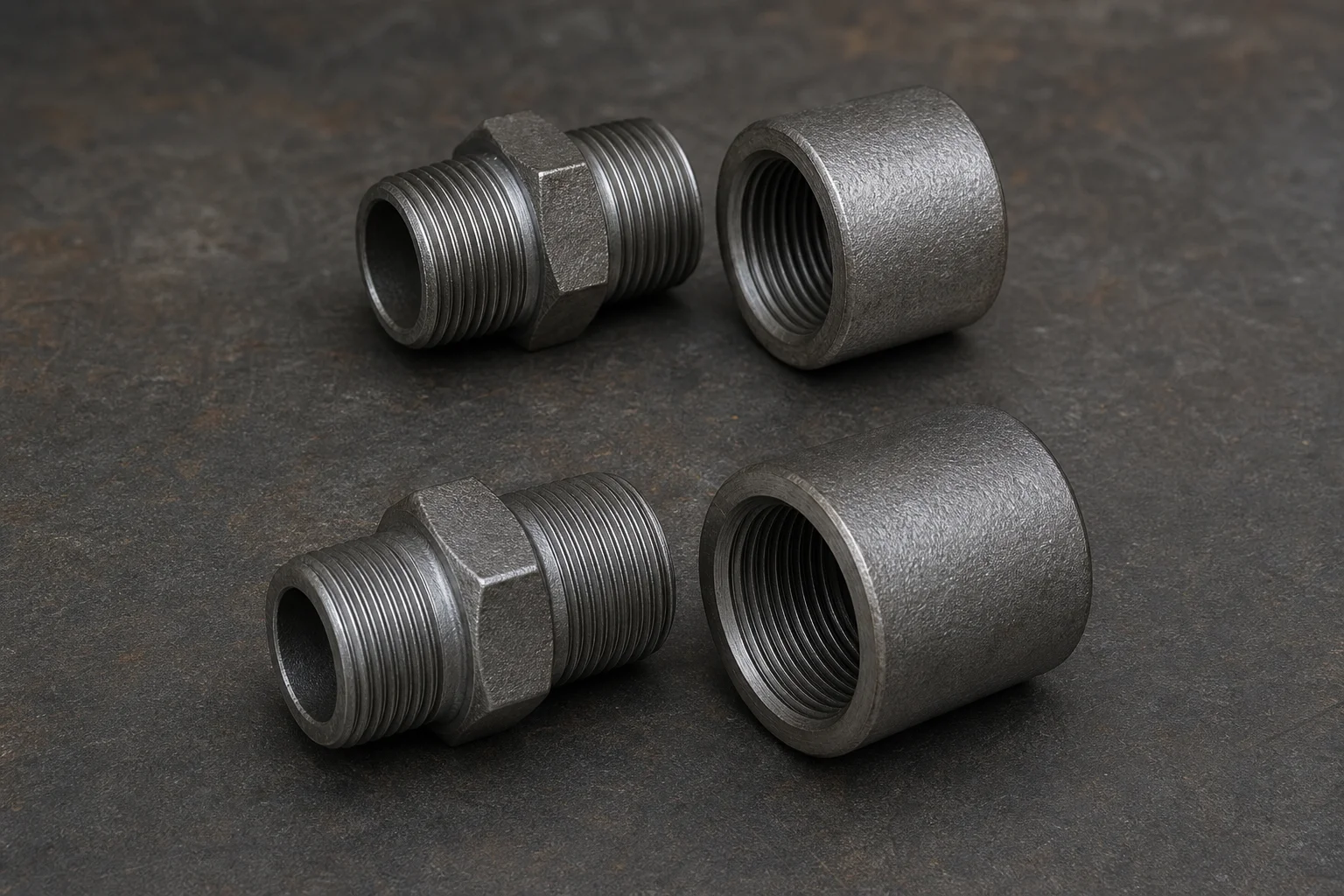
A G 1/2 male can enter some 1/2 NPT female ports for a limited distance, but the flank contact and sealing geometry are wrong. The reverse mismatch can damage the first threads or create misleading tightness.
The nominal fraction is a pipe-size designation, not a direct measured outside diameter. Caliper readings alone can therefore cause misidentification. Pitch and taper need to be checked together with profile and port sealing geometry.
Incorrect adapters are common on imported gauges, valves, pumps, and hydraulic equipment. A rated conversion adapter provides a controlled interface and keeps the two thread systems separate.
Methods, Parameters, or Process
Use the following comparison before selecting a mating fitting or adapter.
| Feature | G 1/2 | 1/2 NPT |
|---|---|---|
| Geometry | Parallel | Tapered |
| Profile family | 55-degree BSP form | 60-degree NPT form |
| Common pitch | Verify from the applicable standard | Common 1/2 NPT uses 14 TPI |
| Primary seal | Washer, O-ring, gasket, or seat | Thread interference plus approved sealant |
| Gauge system | BSPP/G gauges | NPT plug or ring gauges |
| Direct interchange | Not approved as NPT | Not approved as G 1/2 |
Supplier and Inspection Checklist
- Read the equipment drawing and port marking before measuring.
- Check whether the thread is parallel or tapered.
- Measure pitch with the correct thread-pitch gauge.
- Inspect the profile and controlled diameters.
- Identify the sealing face, washer, O-ring, or shoulder on G 1/2 ports.
- Use the correct standard-specific gauge.
- Do not rely on trial assembly or sealant to prove compatibility.
- Select a rated adapter with G 1/2 on one side and 1/2 NPT on the other.
- Confirm adapter material, pressure, temperature, and fluid compatibility.
- Update equipment documentation to prevent future misidentification.
Application to Pipe Fittings, Valves, and Flanges
G 1/2 is common on European and international instruments, valves, pumps, hydraulic manifolds, and sensors. 1/2 NPT is common on North American process piping, gauges, drains, vents, and forged fittings.
When adapting a G 1/2 port, include the correct bonded seal, washer, O-ring, or seat specified by the equipment manufacturer. The NPT side requires its approved assembly and sealant method. The adapter rating must cover the complete service.
FAQ
Is G 1/2 the same as 1/2 BSP?
G 1/2 specifically identifies a parallel BSPP thread. “1/2 BSP” alone can be ambiguous because BSPT forms also exist.
Can PTFE tape make G 1/2 fit NPT?
No. Tape does not correct different thread geometry or sealing locations.
Why do both threads measure larger than half an inch?
The half-inch value is a nominal pipe-size designation, not the direct major diameter.
Which thread has 14 TPI?
The common 1/2 NPT thread uses 14 TPI. G 1/2 uses a different pitch under its standard.
What is the safest conversion method?
Use a purpose-designed, pressure-rated G 1/2-to-1/2-NPT adapter with the correct seals.
Next Steps
Photograph the port, record its marking, identify the sealing face, and verify taper and pitch. Use a rated adapter rather than attempting mixed-thread assembly.
Request a Quote