
Overview
Pipe fittings connect pipe sections, change flow direction, create branches, alter line size, close an end, or provide a transition to equipment and valves. Correct selection requires more than naming an elbow or tee. The buyer must match the fitting to the pipe material, nominal size, wall thickness, end connection, pressure-temperature conditions, fluid, corrosion risk, joining process, and project documents. A fitting that looks correct can still be unusable if its bore, bevel, thread, socket, facing, material grade, or inspection requirements do not match the line specification.
This guide explains the main industrial pipe fittings and the information needed to specify them. It also separates dimensional standards, material specifications, piping-code requirements, and supplier capability. Those documents serve different purposes and should not be treated as interchangeable.
Why It Matters for Pipe Components
A pipe fitting is often a small part of the total piping system, but it can control alignment, flow behavior, weld quality, maintainability, and leak risk. Fittings also create local changes in direction and cross-sectional area. These changes can affect pressure loss, erosion, vibration, drainage, and the ability to inspect or clean the line.
Selection errors usually begin with incomplete descriptions. “Six-inch carbon steel elbow” does not identify the radius, angle, wall thickness, material grade, manufacturing route, end preparation, dimensional standard, or inspection level. “Two-inch threaded tee” does not identify the thread form, pressure class, material, branch size, or whether the thread must be internally or externally protected for shipment.
For procurement teams, complete data reduces clarification cycles and prevents quotations for non-equivalent products. For engineers, it helps preserve the design basis. For contractors, it improves fit-up and reduces rework during installation.
The main functions of pipe fittings are summarized below.
| Function | Typical components | Key information to confirm |
|---|---|---|
| Change direction | Elbows, bends | Angle, radius, size, wall thickness, tangent length if applicable |
| Create a branch | Tees, reducing tees, crosses, branch fittings | Run size, branch size, reinforcement or branch design basis |
| Change line size | Concentric and eccentric reducers, reducing couplings | Large end, small end, orientation, wall thickness at each end |
| Join pipe sections | Couplings, unions, flanges, mechanical connectors | Connection type, dimensions, material compatibility, sealing method |
| Close a line | Caps, plugs, blind flanges | End type, pressure class or wall thickness, removal requirement |
| Connect equipment | Flanges, adapters, nipples, special fittings | Facing, bolt pattern, equipment nozzle details, gasket and alignment needs |
Methods, Parameters, or Process
Which pipe fitting types are used in industrial piping?
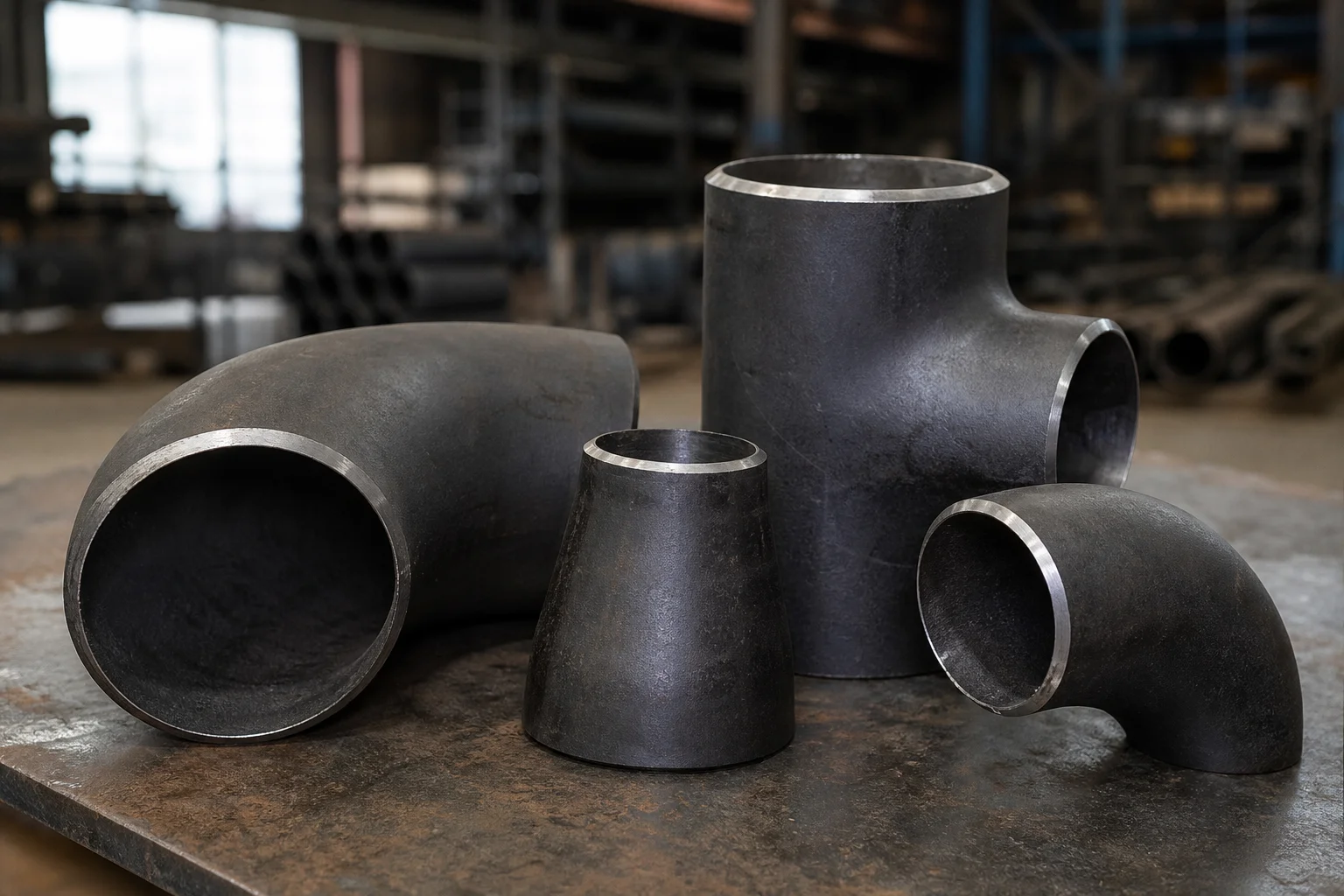
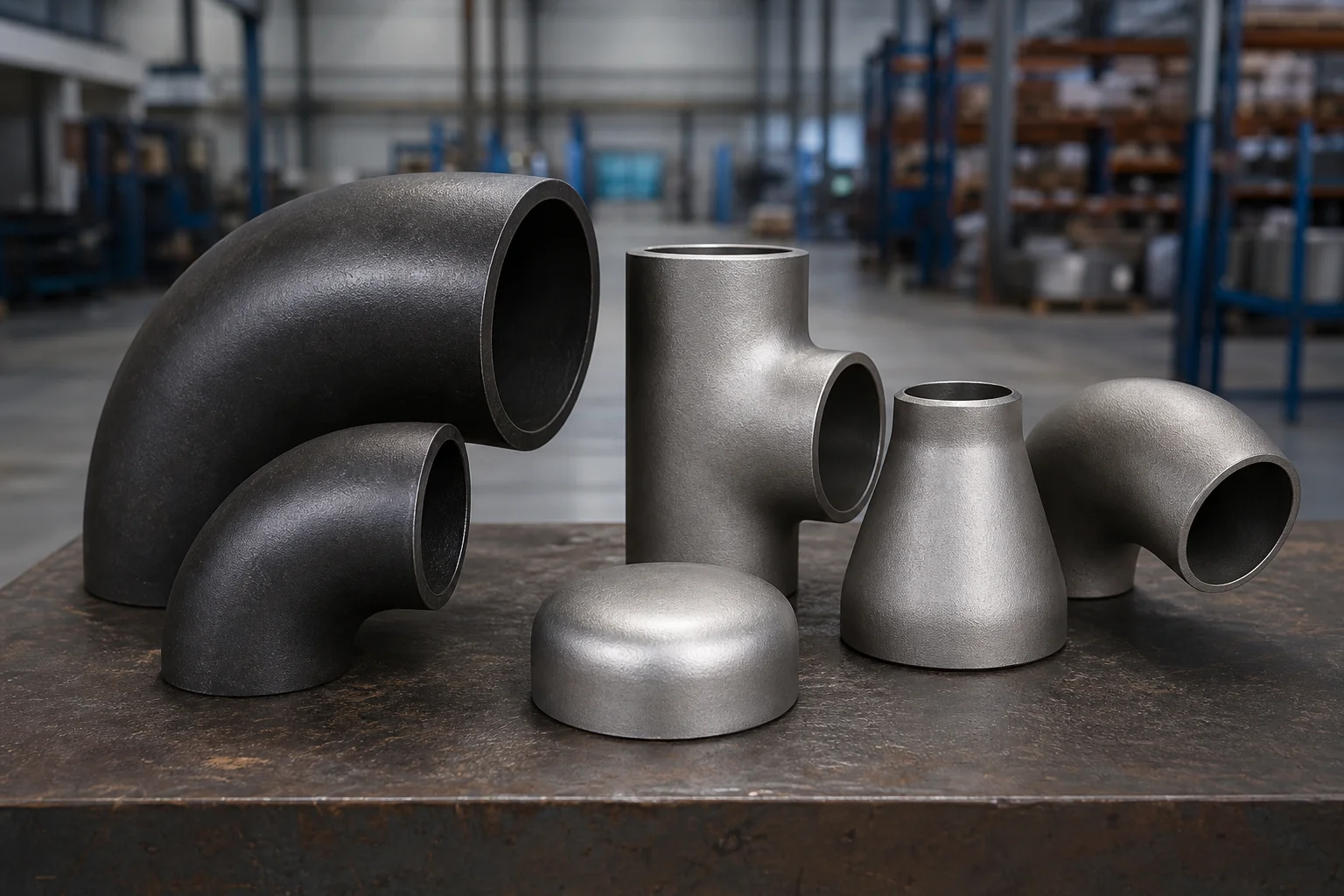
Butt-weld fittings include elbows, tees, reducers, caps, crosses, and other shapes prepared for circumferential welding to pipe. They are common where a continuous welded line, controlled bore transition, and permanent joint are required. The applicable dimensional and material requirements depend on the exact product and project. ASME B16.9 is one widely used dimensional standard for factory-made wrought butt-welding fittings, but it does not replace the material specification or piping code.
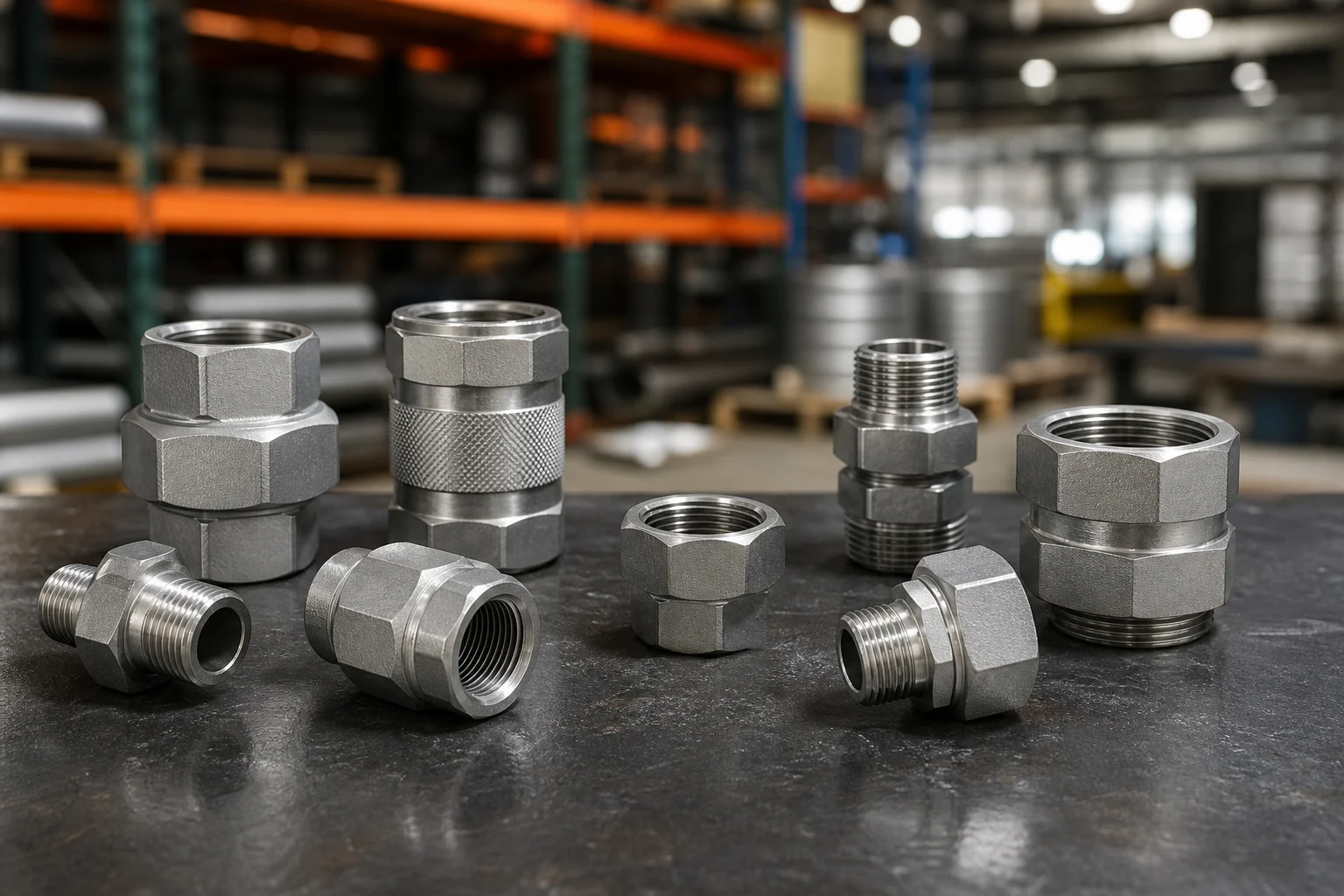
Socket-weld fittings accept the pipe into a recessed socket and are joined by a fillet weld. Threaded fittings join by mating threads. Forged socket-weld and threaded fittings may be specified under ASME B16.11 when that standard is applicable. The permitted size range, pressure class, material, branch arrangement, and service restrictions must still be checked against the line class and piping code.
Flanged fittings and standalone flanges create bolted, gasketed joints. ASME B16.5 is commonly referenced for certain pipe flanges and flanged fittings through its stated size range. Larger or special flanges may require another standard or project drawing. Facing, pressure class, material group, temperature, gasket, bolting, and dimensional compatibility all affect the joint.
Mechanical, grooved, compression, push-fit, and proprietary connectors can be appropriate for specific pipe materials and services. They should not be presented as universal substitutes for welded, threaded, or flanged joints. Manufacturer instructions and project approval are especially important for proprietary systems.
How do connection methods differ?
| Connection | Typical benefit | Main limitations or checks |
|---|---|---|
| Butt-weld | Permanent joint and smooth flow path when correctly matched | Welding procedure, welder qualification, bevel, root gap, wall match, inspection |
| Socket-weld | Compact forged connection for selected small-bore services | Socket dimensions, insertion practice, fillet weld details, service limitations |
| Threaded | No field welding and easy assembly for suitable services | Thread form, sealant, engagement, pressure/temperature limits, vibration and cyclic service |
| Flanged | Removable joint for valves, equipment, and maintenance | Facing, class, gasket, bolting, alignment, flange rotation and surface condition |
| Mechanical or grooved | Fast installation and controlled flexibility in approved systems | Pipe-end preparation, gasket compatibility, housing rating, manufacturer approval |
| Compression | Useful for compatible tubing or pipe systems | OD tolerance, ferrule or seal compatibility, installation procedure, reuse limits |
Which materials are commonly specified?
Carbon steel is widely used for process, utility, power, and general industrial piping. Stainless steel is selected where corrosion resistance, cleanliness, or temperature performance requires it. Alloy steels may be needed for elevated-temperature or specific process service. Low-temperature materials, nickel alloys, copper alloys, ductile iron, malleable iron, and polymer fittings serve other defined applications.
A material family is not a complete specification. “Stainless steel” does not establish grade, product form, heat treatment, corrosion resistance, or allowable service. “Carbon steel” does not show whether the item is wrought, forged, cast, fabricated, or made to a particular material specification. The purchase order should state the exact required material designation and any supplementary requirements.
Avoid assuming equivalence between ASTM, EN, DIN, ISO, GOST, or national grades. Cross-reference tables may be useful for preliminary discussion, but final acceptance should be based on the project-approved specification and verified chemical, mechanical, heat-treatment, and product-form requirements.
How do NPS, DN, schedule, wall thickness, and pressure class affect selection?
NPS and DN are nominal pipe-size designations. They are not always direct measurements of outside diameter or inside diameter. Pipe outside diameter is controlled by the selected dimensional system, while inside diameter changes with wall thickness. For a fitting, the buyer should identify the nominal size and the required end wall or schedule. When two ends differ, each end must be stated.
Schedule is primarily a pipe wall designation. It should not be used as a substitute for a forged fitting pressure class or flange pressure class. Likewise, a flange class does not mean the flange has the same allowable pressure at every temperature or in every material group. The selected standard, material group, design temperature, gasket, bolting, and system code must be evaluated together.
For reducers, branch fittings, and custom transitions, check whether the supplier needs end wall thicknesses, bore dimensions, center-to-end dimensions, tangent lengths, or a drawing. A schedule label alone may be insufficient where the project controls the actual minimum wall.
Which standards and project documents should buyers verify?
A robust order separates four document types:
1. Piping code or system code: establishes design, fabrication, examination, and service rules for the piping system. 2. Dimensional standard: controls geometry, tolerances, end preparation, marking, or ratings for a defined product range. 3. Material specification: controls product form, grade, chemical composition, mechanical properties, heat treatment, testing, and certification. 4. Project specification or line class: combines the project’s approved materials, components, corrosion allowance, joint types, inspection, and documentation.
Do not write “ASME fitting” without identifying the actual standard and product. Do not assume that compliance with one dimensional standard proves compliance with the material specification or project code. Record the standard edition required by the purchase order. If the edition is not stated, mark it [verification required] before release.
How should service conditions be evaluated?
Confirm design pressure, design temperature, operating range, fluid, phase, solids content, corrosive species, external environment, cyclic duty, vibration, cleaning method, fire exposure, and any sour, oxygen, hydrogen, hygienic, cryogenic, or high-temperature requirements. The project engineer should determine the governing design and material rules.
Flow considerations also matter. A long-radius elbow may reduce local loss compared with a sharper turn, but the actual choice depends on space, standard availability, erosion risk, pigging, and project design. An eccentric reducer may be selected to manage drainage or vapor pockets, but orientation must follow the system design rather than a universal slogan.
Supplier and Inspection Checklist
Before approving a supplier or shipment, check the following:
- Product type, angle, radius, run size, branch size, and reducing orientation match the purchase order.
- Material marking matches the material certificate and approved specification.
- Heat or lot traceability is maintained at the level required by the project.
- Outside diameter, end wall, center-to-end dimensions, bevel, socket, thread, and flange details are measured using the applicable drawing or standard.
- Welded or fabricated fittings have approved manufacturing and examination records when required.
- Surface condition, coating, galvanizing, pickling, passivation, or painting matches the order.
- Ends are protected against impact, contamination, corrosion, and thread damage.
- Required tests and examinations are identified by method, acceptance criteria, coverage, and responsible party.
- Material test certificates, inspection reports, nonconformance records, and release notes are complete.
- Marking and packaging preserve identification through transport and site storage.
Inspection terms should be precise. “NDT required” is incomplete. State the method, location, extent, acceptance criteria, applicable procedure, personnel qualification requirement, and reporting format. Requirements for radiography, ultrasonic testing, magnetic particle testing, liquid penetrant testing, hardness, impact testing, positive material identification, or hydrostatic testing depend on the product and project.
Application to Pipe Fittings, Valves, and Flanges
Pipe fittings must connect cleanly to pipe, valves, flanges, strainers, pumps, vessels, and instruments. A valve end connection should be checked against the adjoining pipe and fitting, including facing, bore, schedule, class, end preparation, and material. A reducing fitting placed directly beside a valve may affect access, drainage, turbulence, or maintenance space.
Flanged joints require a coordinated package: flange standard and class, facing, gasket, bolting, surface finish, alignment, and tightening procedure. A flange with the correct nominal size can still be incompatible if the drilling, facing, bore, or pressure-temperature basis differs.
For welded assemblies, fit-up should control bore mismatch and angular alignment. For threaded assemblies, the exact thread standard and sealing method must be confirmed. For socket-weld assemblies, socket and pipe dimensions must match, and installation should follow the approved welding procedure and project requirements.
Related product families may include butt-weld elbows, tees, reducers, caps, forged fittings, and flanges. Selection should begin with the line class or approved piping specification, not with a catalog photograph.
FAQ
What is the difference between a pipe fitting and a pipe connector?
“Pipe fitting” is a broad term covering elbows, tees, reducers, caps, couplings, unions, adapters, and other components. “Pipe connector” usually describes a component whose main function is joining two pipe or tube ends. Usage varies by market, so the exact product type and connection should be stated.
Are pipe fittings measured by inside diameter or outside diameter?
Industrial pipe systems normally use nominal size designations supported by controlled outside diameters and specified wall thicknesses. Tubing is commonly ordered by actual outside diameter and wall thickness. Always identify the measurement system and product standard.
Can the same fitting be used for different pipe schedules?
Sometimes a fitting body may be supplied for more than one end wall, but bore match, end thickness, minimum design wall, bevel, and project requirements must be verified. Do not assume interchangeability from nominal size alone.
Does a pressure class equal a fixed pressure rating?
No. The allowable pressure generally depends on the product standard, material, temperature, design rules, and other joint components. Use the applicable pressure-temperature tables and project design basis.
What information is most important in an RFQ?
State product type, size, end wall or schedule, material specification and grade, dimensional standard, end connection, pressure class where relevant, quantity, inspection, certificates, coating, marking, packaging, delivery location, and required date. Attach drawings for nonstandard items.
Next Steps
Prepare a line-item schedule before requesting a quotation. Include the fitting type, nominal size, wall thickness or schedule, material specification and grade, applicable dimensional standard, connection, quantity, inspection scope, certificates, surface treatment, marking, packaging, delivery location, and drawings. Mark any missing standard edition, rating basis, or dimensional value as [verification required] rather than allowing the supplier to guess.
Request a Quote