
Overview
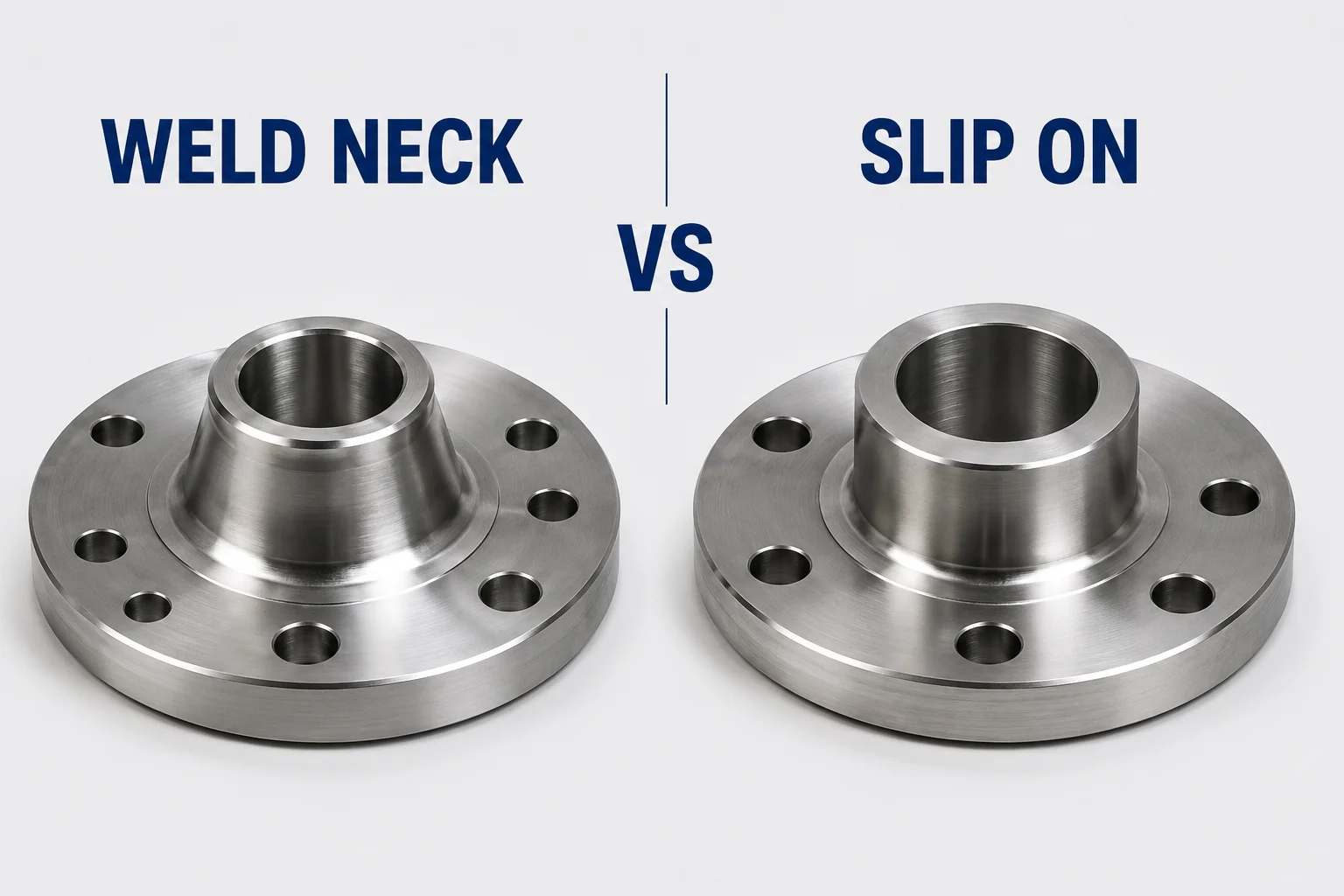
A weld neck flange connects to pipe with a butt weld at the tapered hub. The hub provides a gradual transition from the flange body to the pipe, so this type is often selected where pressure, temperature, cyclic loading, or joint reliability is important. Selection still depends on the governing piping code, the project specification, and the matching pipe wall.
Why It Matters for Pipe Components
The connection geometry affects alignment, stress transfer, weld examination, and future maintenance. A flange that matches the nominal pipe size but has the wrong bore can create an internal step at the weld. A flange with the wrong pressure class or facing will not correctly match the mating flange and gasket system.
ASME B16.5 covers pipe flanges and flanged fittings from NPS 1/2 through NPS 24. ASME B16.47 covers large-diameter steel flanges from NPS 26 through NPS 60. These standards control dimensional and rating information within their stated scope, but the piping design code and project documents decide whether a flange is suitable for the actual service.
Methods, Parameters, or Process
Specify a weld neck flange in a controlled sequence.
| Parameter | What to state on the inquiry or purchase order | Why it matters |
|---|---|---|
| Dimensional standard | ASME B16.5, ASME B16.47, EN 1092-1, or project standard | Controls dimensions, drilling, and designation |
| Nominal size | NPS or DN | Defines the flange size series |
| Rating | ASME class or PN designation | Must match design conditions and mating equipment |
| Facing | RF, FF, RTJ, or project-specific facing | Must match the gasket and mating flange |
| Material | Full material specification and grade | Controls chemistry, heat treatment, and testing |
| Bore or pipe schedule | Pipe schedule, wall thickness, or specified bore | Supports a smooth weld transition |
| End preparation | Bevel details from drawing or WPS | Controls fit-up and welding |
| Documentation | MTR, inspection certificate, NDE, and dimensional report as required | Supports traceability and release |
Do not assume that “standard bore” is enough. Ask the supplier to confirm the bore against the pipe outside diameter and wall thickness. For large or heavy flanges, also confirm handling points, lifting method, and any project-specific ultrasonic examination requirements.
Verification note: exact dimensions, tolerances, pressure-temperature ratings, and marking requirements must be checked against the purchased edition named by the contract.
Supplier and Inspection Checklist
- Confirm the standard, edition, size, class or PN, facing, and material grade.
- Match the flange bore to the actual pipe wall or approved transition detail.
- Review heat number traceability from raw material to finished flange.
- Check hub profile, flange thickness, outside diameter, bolt circle, hole diameter, and facing dimensions.
- Verify surface condition on the gasket contact area.
- Confirm required NDE, mechanical tests, impact tests, hardness tests, PMI, or corrosion tests from the purchase specification.
- Review marking and certificates before shipment.
- Keep weld preparation protected from dents, rust, and coating contamination.
Application to Pipe Fittings, Valves, and Flanges
Weld neck flanges are used on process piping, valves, pressure equipment nozzles, pumps, and fabricated piping assemblies. They are especially useful where the designer wants a butt-welded transition and good alignment control. They are not automatically required for every severe service; the approved piping class and engineering specification remain the controlling documents.
For fittings and valves, verify that the flange class, facing, bore, and material are compatible with the adjoining component. For prefabricated spools, the fabricator should control flange orientation, bolt-hole straddling requirements, weld shrinkage, and final face alignment.
FAQ
Is a weld neck flange always better than a slip-on flange?
No. It offers a different connection geometry and is often preferred for demanding services, but suitability depends on the design code, piping class, cost, fabrication plan, and inspection requirements.
How is the correct bore selected?
Use the actual pipe outside diameter and wall thickness or the approved piping class. The bore should support the specified weld profile and internal transition.
Can ASME B16.5 dimensions be used for every flange size?
No. ASME B16.5 covers NPS 1/2 through NPS 24. Large-diameter steel flanges may fall under ASME B16.47 or another project standard.
What documents should a buyer request?
Common documents include a material test report, dimensional report, heat-treatment record when applicable, NDE reports when specified, and a certificate of conformity. The contract must state the required level.
Next Steps
Send the supplier the complete flange designation, pipe wall, material grade, quantity, inspection level, and required standard edition. Request a marked-up drawing before production when the bore, hub, or facing is not fully defined.
Request a Quote