Elbow center-to-end dimension and schedule verification: Español industry guidance
Elbow geometry verification before fit-up
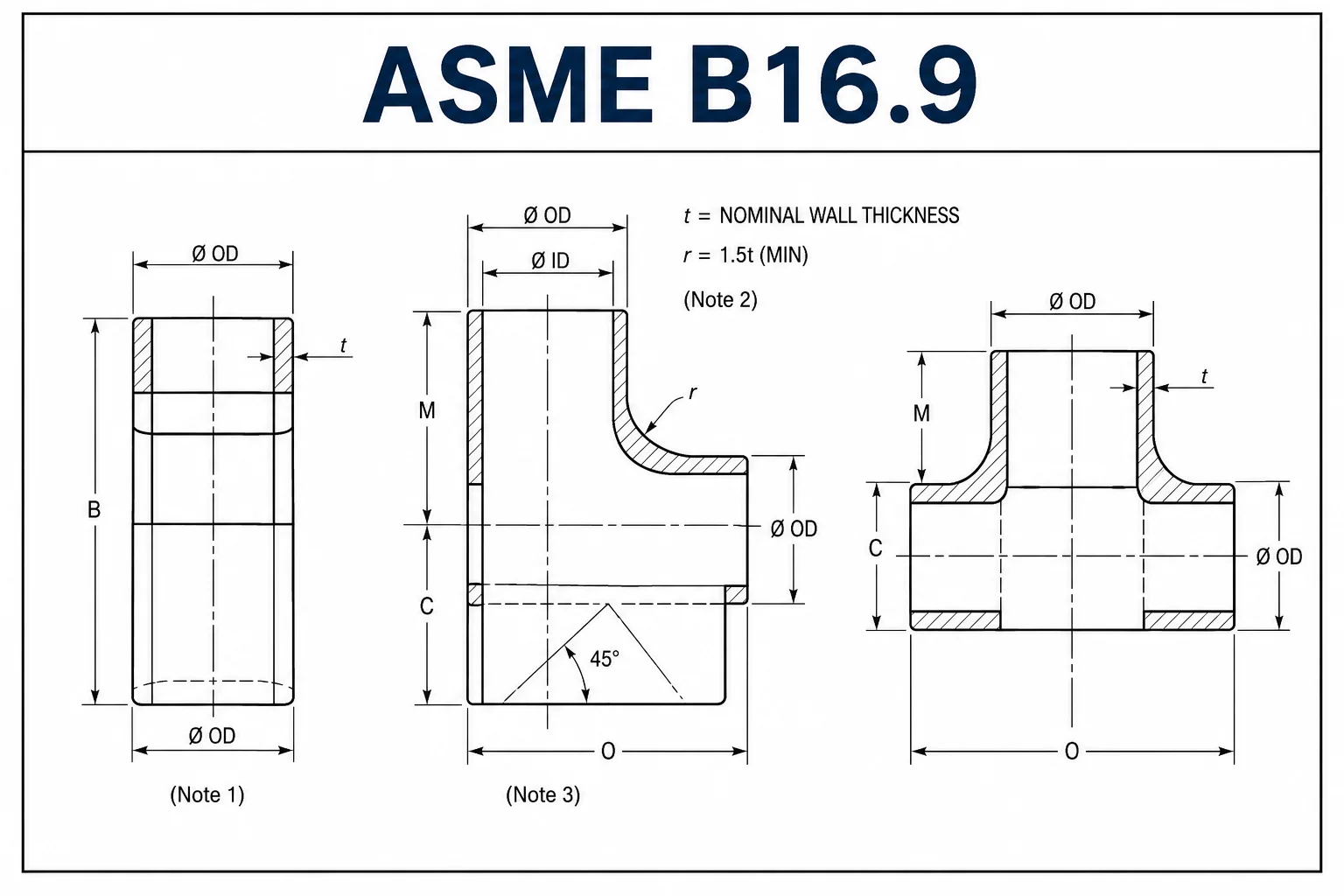
Project delay often starts from a small assumption: elbows with correct nominal size are treated as interchangeable. In practice, center-to-end basis, LR/SR selection, and schedule consistency decide whether spools align without forced fit.
This guide uses an industry-guidance approach: freeze dimensional logic at PO stage, verify critical values before fabrication release, and repeat targeted checks at receiving. The objective is to avoid field correction welding, alignment stress, and claim-driven schedule loss.
When the same acceptance logic is applied from quotation to receiving, teams cut urgent rework, preserve installation sequence, and reduce avoidable commercial disputes.
Checklist for purchasing, fabrication, and receiving
Apply the same verification thread through RFQ, PO, and incoming inspection so engineering intent does not drift between drawing and site execution.
- Specify LR or SR explicitly and bind it to the exact dimensional standard revision.
- Freeze center-to-end critical values and tolerance class per size range in controlled PO attachments.
- Lock schedule requirement with material traceability; do not accept label-only confirmation.
- Define which deviations are rejectable and which can be dispositioned before any fit-up starts.
- At receiving, perform marking check, random wall-thickness check, center-to-end spot check, and bevel condition check.
- Archive measurable evidence in the lot dossier so later fit-up disputes can be resolved by records, not memory.
Why this controls total project risk
Most cost is generated by late discovery in fabrication yard or site, not by unit price difference. Early dimensional control protects schedule, weld quality, and turnover reliability.
FAQ for buyers and inspectors
Can LR and SR be substituted when size is the same?
Only with engineering approval. Different center-to-end values can shift spool geometry and introduce forced alignment.
Why verify schedule again at receiving?
Because marking can be correct while wall distribution in mixed lots still causes mismatch risk.
What PO fields reduce fit-up claims most effectively?
Dimensional basis, LR/SR requirement, schedule rule, tolerance standard, and receiving acceptance method in one locked set.
Run a controlled verification flow
Share your elbow list and project drawing basis. Hebei Nuoan can provide a practical verification checklist for center-to-end, LR/SR, schedule, and receiving acceptance.
Request technical review