Overview
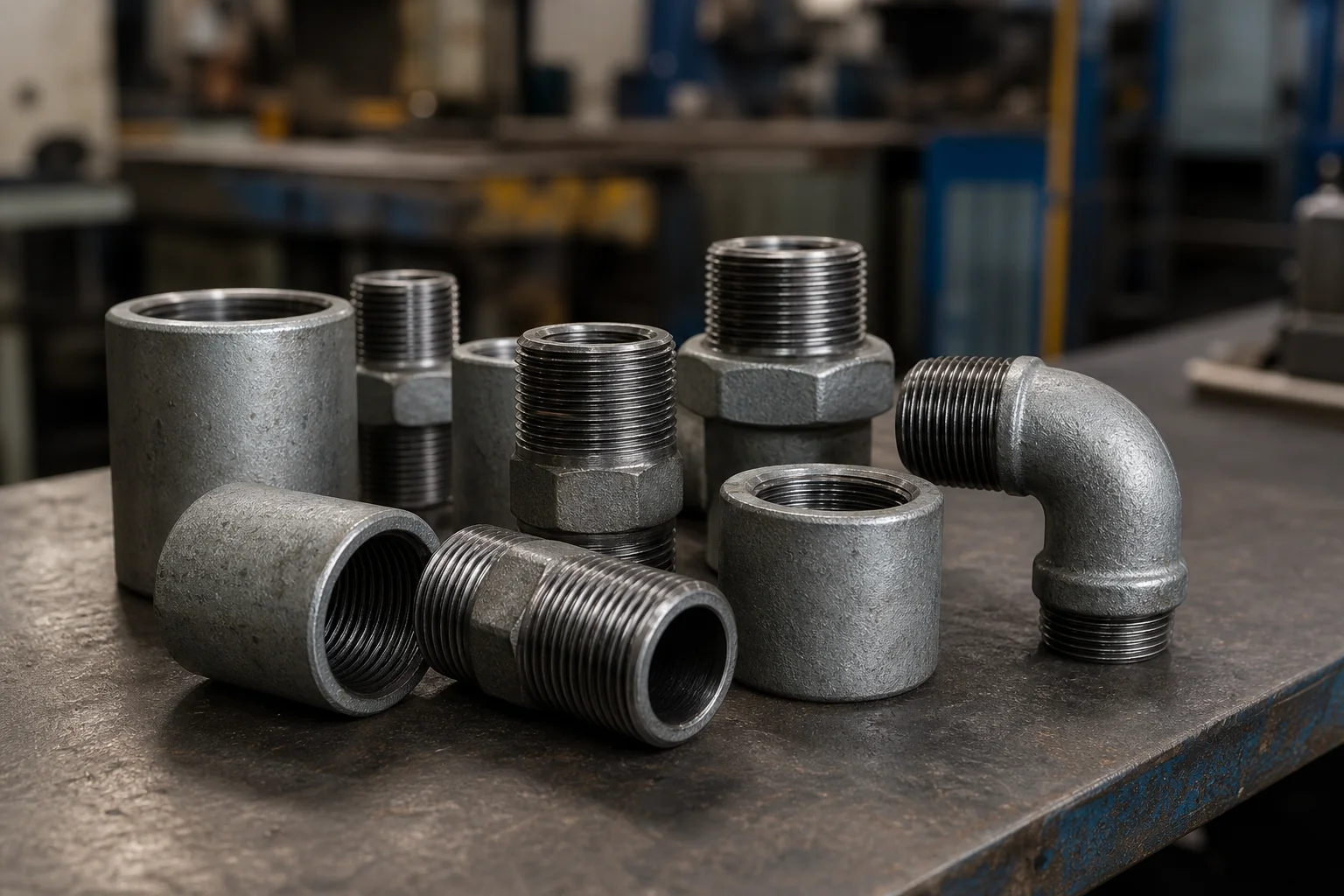
Threaded flanges connect to externally threaded pipe without a flange-to-pipe weld. They are also called screwed flanges in some markets. The threaded bore must match the pipe thread system, size, taper or parallel form, pitch, and tolerance required by the project.
Threaded flanges are useful where welding is undesirable or impractical, but they are not a universal replacement for welded flanges. Service temperature, pressure, vibration, cyclic loading, leakage risk, corrosion, thread galling, pipe wall, piping code, and owner restrictions all affect suitability.
A major procurement risk is writing only “2-inch threaded flange.” That does not state whether the thread is NPT, BSPT, BSPP, or another system, nor does it define flange standard, class/PN, facing, or material.
Why It Matters for Pipe Components
Thread mismatch can make two nominally equal components impossible to assemble or can create a joint that engages only a few threads. NPT and BSP threads, for example, differ in thread form and should not be treated as interchangeable just because nominal size is similar.
Threaded connections also remove material from the pipe wall. The piping designer must ensure the selected pipe schedule and thread form are suitable for the pressure and service. Thin-wall pipe may not be appropriate for certain threaded joints. Thread engagement length, machining quality, and the remaining wall at the thread root should therefore be reviewed as part of the joint design rather than checked only after assembly.
For corrosive or high-temperature service, sealing compound, thread material combination, and maintenance practice matter. Stainless threads can gall if assembly controls are poor. Carbon steel threads can corrode in exposed environments. These are system issues, not flange-only issues.
Methods, Parameters, or Process
| Parameter | What to verify |
|---|---|
| Flange standard | Dimensional and pressure-rating basis |
| Nominal size | NPS/DN as applicable |
| Pressure designation | Class/PN |
| Thread system | NPT, BSPT, BSPP, metric, or project-specific |
| Thread designation | Exact size, pitch/TPI, taper/parallel form |
| Facing | RF, FF, or other specified facing |
| Material | Exact specification/grade |
| Pipe wall | Sufficient for the required thread and service |
| Sealant | Approved for process fluid and temperature |
| Gauge inspection | Correct thread gauges where required |
ASME B16.5 includes threaded flanges within its scope, while ASME B1.20.1 is a commonly referenced standard for NPT pipe threads. Other markets use ISO or British pipe-thread standards. The flange drawing and PO should identify the required system explicitly.
Thread acceptance should use the gauges and criteria required by the thread standard and project specification. Measuring only the major diameter with a caliper does not fully verify a tapered pipe thread.
Supplier and Inspection Checklist
- Specify the exact thread standard and designation.
- Do not mix NPT, BSPT, BSPP, or metric thread descriptions.
- State flange nominal size, pressure class/PN, facing, and standard.
- Confirm material specification and grade.
- Check that the connected pipe wall is suitable for threading.
- Use correct plug/ring gauges or other specified thread inspection tools.
- Inspect threads for damage, burrs, tearing, corrosion, or contamination.
- Protect threads with caps or plugs during transport.
- Confirm permitted sealant or tape for the process service.
- Verify flange drilling, OD, thickness, and facing separately from the thread.
- Review project restrictions for toxic, flammable, cyclic, vibration, or high-temperature service.
- Maintain traceability and MTC records when required.
Application to Pipe Fittings, Valves, and Flanges
Threaded flanges are often used with threaded pipe, nipples, couplings, and small-bore forged fittings. All components must use the same thread system. A threaded valve may connect directly to pipe, while a threaded flange can transition a threaded line to flanged equipment.
When threaded flanges are used near pumps or reciprocating equipment, vibration and cyclic loading deserve engineering review. A joint that is tight at installation can loosen or leak if the service is unsuitable for threaded construction.
At flanged equipment, the outer flange dimensions still follow the selected flange standard. Thread compatibility on the pipe side does not guarantee bolt compatibility on the equipment side.
FAQ
Are threaded flanges welded to the pipe?
Normally no. Their purpose is to connect to threaded pipe without a flange-to-pipe weld. Any additional seal welding or special treatment must be specifically engineered and approved.
Is a threaded flange the same as an NPT flange?
Not always. NPT is one thread system. A threaded flange can be manufactured with other thread forms if the design and standard permit them.
Can BSP and NPT threaded flanges connect?
They should not be assumed compatible. Thread angle, pitch, and form can differ. Use the exact matching thread standard.
How are threaded flanges inspected?
Check flange dimensions and facing like other flanges, then inspect thread form and engagement using the specified gauges and acceptance criteria.
Next Steps
Put the exact thread standard and designation on every RFQ and drawing. Ask the supplier to confirm gauge inspection and provide a thread detail when the connection system is unusual. Exact thread dimensions and acceptance limits should be verified against the project-specified thread standard.
Request a Quote